Coney Island
The WhaleConey Island is the setting for a formative encounter between the narrator and a captive beluga whale, and a place where seaside entertainment turns into an uneasy confrontation with human control over marine life. Its off-season attractions and aquarium frame the whale not as a distant ocean creature but as a living presence confined behind glass. The encounter also recalls earlier attempts to exhibit belugas, making Coney Island part of a recurring history in which curiosity about whales has been joined to the business of displaying them.
Setting and first visit
On the narrator’s first visit to America, in January, alone and homesick in New York City, the subway journey ended at Coney Island. The amusement structures appeared in silhouette; the roller coaster was hibernating, and the boardwalk and suburban sea seemed forlorn. The aquarium was nearly empty. Its fish tanks did not prepare the narrator for what waited beyond them: in this out-of-season setting, the visitor’s attention shifted from public entertainment to the isolation of a single large animal.
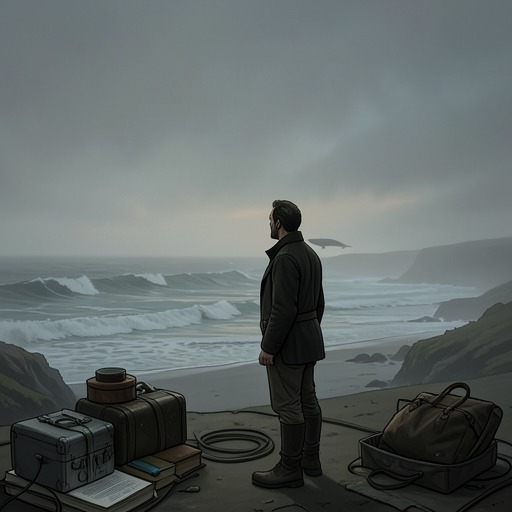
The scene draws force from the contrast between the city and the sea. Coney Island is a coastal place, but the winter visit offers no expansive ocean spectacle. Instead, the aquarium presents water in bounded tanks and makes a marine animal available to look at. Elsewhere, the sea is described as an enduring wilderness that human beings mistake for something they have tamed or reduced to a distance to cross. At Coney Island, that tension takes a concrete form: an animal from Arctic waters occupies a civic enclosure, while the sea beyond remains largely absent from view. The aquarium makes the whale visible, but not in its own world.
The beluga at the window
An observation window was set into the aquarium’s white wall, thick enough to withstand the pressure of the water. On the other side, a beluga appeared upright and nearly full length, roughly twelve feet from its bulbous head to its stubby flukes. Its direct gaze made the encounter feel less like viewing a specimen than meeting an animal that had become unexpectedly present within the building.
The pane establishes both contact and separation. It allows the narrator to look closely, but the whale remains inaccessible on the far side of a barrier designed to contain water. The narrator responds with fascination and pity, seeing the beluga as profoundly out of place, rather than as a natural feature of the entertainment venue. Its white skin, the algae on the glass, and the stillness of the visit give the encounter its particular force: the visible animal is present, but the life it would lead in open water is not.
That separation becomes especially poignant because belugas are known for their vocality. Sailors call them the canaries of the sea, yet this captive animal is described as silent in the aquarium. The narrator reaches toward it through the thick glass and waits for a response, but the beluga does not raise a flipper. The attempted contact ends not in exchange but in the narrator turning away, unable to continue meeting its stare. Coney Island thus becomes the setting for a small reversal: the visitor arrives to look at an attraction, then leaves under the pressure of recognizing the limits of that gaze.
Earlier whale displays
The beluga at Coney Island had a precedent in the nineteenth-century exhibition trade. In 1861, Phineas T. Barnum imported two belugas from waters off Labrador for Barnum’s American Museum on Broadway. They were transported south in sealed boxes lined with seaweed and placed in a basement tank measuring fifty-eight by twenty-five feet, less than seven feet deep and filled with fresh water. The whales swam together there, but even Barnum expected their display careers to be brief. Their deaths within days, followed by the replacement of one pair of specimens with others, show how novelty and public demand repeatedly outweighed the animals’ prospects of survival. A fire destroyed the museum in 1865; attempts to rescue the final beluga failed.
Another beluga’s route linked Coney Island to a later London exhibition. Captured off Labrador, it was taken in a box by sloop to Montreal and then by train to New York, a journey that lasted two weeks. It spent seven months at Coney Island’s Summer Aquarium, where it developed a habit of swimming in a circle. It was then removed from its tank and sent across the Atlantic aboard the steamship Oder, kept in a seaweed-lined wooden box on deck and wetted with salt water every three minutes. After reaching Southampton, it travelled by rail to its new tank at the Royal Aquarium, Westminster. This itinerary makes Coney Island more than a backdrop to one visit: it was a temporary stop in a long, managed passage that carried a whale from its capture toward another public display.
Significance
The location’s significance lies in the contrast between entertainment and confinement. The aquarium invites spectators to regard the beluga as a spectacle, while the narrator’s response unsettles that arrangement. The whale’s size, gaze, and capacity for sound insist on an animal life that cannot be reduced to the role assigned by its tank. The pane is therefore both a viewing device and a boundary: it brings the animal close enough to fascinate, while making clear that looking does not restore its freedom.
Coney Island’s winter quiet intensifies that contradiction. The narrator encounters the beluga not amid a thriving crowd but in an almost empty aquarium, where the animal’s captivity seems to stretch beyond the immediate visit into the afternoons ahead. Read beside the earlier displays and the beluga’s onward journey, this meeting becomes part of a repeated pattern of capture, transport, exhibition, and loss. The place concentrates the book’s larger question about the sea: whether human beings can truly know or possess marine life, or whether the effort to make it an attraction instead reveals how much remains outside their control.